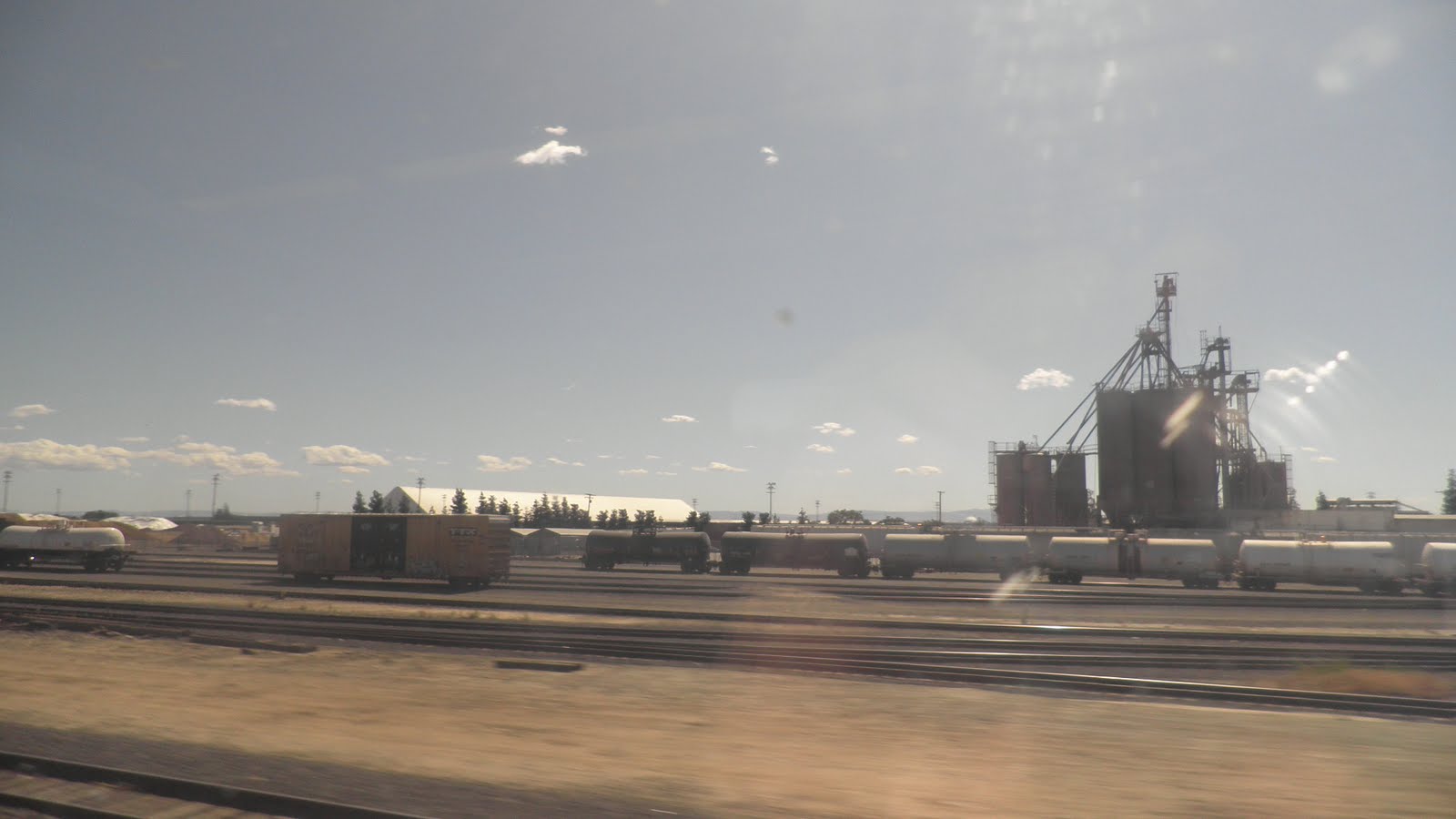
I thought about including my little adventures in central California and more precisely in Fresno in my article about San Francisco. However, I think that it deserves an article on its own.
Fresno is not a city easily reachable by public transport. It still benefit from six trains per day thanks to the San Joaquin Line of the AMTRAK. A bus line manned by Greyhound is also available. An airport is present in the city but I have not really checked for that opportunity.. I took the train and was a bit surprised by how slow it was going. Nevertheless, it was comfortable and I had a lot of space for my legs. It also gave me the opportunity to enjoy the rural landscape of California and to learn more about it. The countryside seems to be a really nice place often sunny, as it was this day, but I did not expect to see so many decrepit factories along the way. They reminded me of the 50’s-70’s. As expected, I saw a lot of orange trees field, vineyards and some beehives. Nevertheless, there is a difference between a city like San Francisco and this countryside which seems to be stuck some decades behind as the towns that the train serves have a kind of miserable feel about them that does not lent toward dynamism. Interestingly it reminds me that in America, cheap can sit with no shame next to poshness. In addition of being the country of opportunity, the USA are perhaps also a country of great contrasts whether they be geographical or social. Overall, the car remains the best way to reach it and enjoy the city.
Indeed, the city’s structure reminded me a lot of Johannesburg in South Africa. Down-Town is kind of deserted and riddled by crime, as I was told. It was a sad thing for me to see as I hate a city with no real centre. Some buildings deserve more attention and the central streets could use more high-profile trade and shops rather than some cheap Hispanic shops. As a matter of fact, most of the big name will be found in malls scattered all over the city. And as the commuting is pretty much inexistent and that the city has expanded a lot, walking is not an effective way to reach a point, even for me! So the car remains the best way to travel around. It is obviously a vicious circle as nothing seems to be done to make people walk more. I am curious to know if the situation of Fresno, fifth biggest city in California with more than half a million inhabitants, is unique in America or if second rate cities across the country share the same flaw. Looking at the demographic statistics reveals that the city population boomed in the 90’s and that it probably suffered from a bad city development and now it would take a lot of effort to restrain the expansion of the city as no buildings exist in order to stall it. So the more the city grows, the more it expands and the more things get scattered.
Anyway, thanks to my designated driver, I could enjoy all the services that a city could offer. It is just that everything is scattered all over the place which might be a bit frustrating and I do not think that it is a positive motivational factor when the question of going out or doing some activities is raised. I have been able to enjoy a base-ball match where the local team, the Grizzlies, were trounced by the visitors. At first, this sport is to me as interesting as cricket as I do not fully grasp how it works. Yet, I am persuaded that if I had to live in the country, I could learn to appreciate it for its dynamic and relaxed ambiance and of course for its foot-long hotdog!
The proximity of a lot of natural parks should make of Fresno an ideal hub but it seems to be left unexploited and I am pretty sure that the fact that it is hard to be reach for tourists and backpackers does not help at all. In addition, the city is barely known abroad. I have a feeling that a lot of things could be done in this city but that people do not know how to deal with it because most of the competent persons leave the city and only the less motivated stay. Indeed, in the current state; why would they stay when they could go to bigger and more exciting cities? Interestingly, one of its sister’s cities is Verona in Italy: a city cradled in culture and history; it should be for Fresno a great way to improve its own status. Indeed, if the USA is not reputed for its fine culture and its long history, they are on the other hand a major actor on the outdoor’s activities scenes and Fresno happens to be close to a lot of them while being not so far from seaside and mountain activities. If the city is broke, why could not they use their potential outlaws, since crime is rife there, to help them develop the city instead of parking them into some overcrowded prisons? What’s going on there?
-C
Showing posts with label domestic affair. Show all posts
Saturday, May 29, 2010
Wednesday, April 7, 2010
Is the sun setting on California?
In order to get out of its nightmarish financial situation, the state of California has decided to vote two bills supposed to help solving this problem. Indeed, its penitentiary system is to be lightened and marijuana is to be legalised.
I can see the point of why it would be easier to save and gain money. I am also aware that the judiciary system in California is tough and thus it is one of the main causes in the overpopulation of its penitentiary facilities. 150,000 inmates are at the moment in the prisons and the bill aims to reduce this number by 55,000 over 3 years by shortening sentences, releasing people inculpated for minor sanctions and other mechanics. Prisons are often reaching the double of their designed capacities making the living conditions in them hard to manage; classrooms and gymnasiums had to be converted so that they could allow prisoners to sleep in. This reform would save from $803M to $906M per year and is endorsed by Governor Schwarzenegger. However, this problem does not only concern the state of California but the whole country, and as a matter of fact a lot of nations suffer from this problem. In 1972, there were 172,000 prisoners in the USA while now this number has skyrocketed to 1,403,091 people.
The bill on the legalisation of the marijuana would make of California the first state to legalize its use in the USA. A poll in April 2009 revealed that 56% of the Californians were favourable to it while in October 44% of the Americans would not mind this step. Proponents argue that it would diminish crime linked to the traffic as the ban has bolstered an aggressive underground economy while opponents argue that it would increase the problems linked to social behaviour notably on the road.
This bill, if passed, in conjunction with the prison bill would allow California to significantly reduce its prisons population and increase its finances thanks to a tax on the commercialisation of marijuana.
I am a bit dubitative at this double decision as I do not really know what would be the impact of such measure on the society. Does this mean that the cartels controlling drug traffic are going to be out of business without trying anything and thus crime will fall? Does this mean that people susceptible of a federal offense will take more liberties confident in the fact that minor crimes will be less punished? Will there be more troubles linked to the consumption of marijuana? Or are these more laxist measures supposed to perpetuate the ideal of happiness in the country blessed by God?
These events combined with the failure of the education in California do not announce a bright future to me. I do not really see how it would be beneficial for the society to profit from these bills. Is it a sign of the degeneration of the American society or of an evolution?
-C
I can see the point of why it would be easier to save and gain money. I am also aware that the judiciary system in California is tough and thus it is one of the main causes in the overpopulation of its penitentiary facilities. 150,000 inmates are at the moment in the prisons and the bill aims to reduce this number by 55,000 over 3 years by shortening sentences, releasing people inculpated for minor sanctions and other mechanics. Prisons are often reaching the double of their designed capacities making the living conditions in them hard to manage; classrooms and gymnasiums had to be converted so that they could allow prisoners to sleep in. This reform would save from $803M to $906M per year and is endorsed by Governor Schwarzenegger. However, this problem does not only concern the state of California but the whole country, and as a matter of fact a lot of nations suffer from this problem. In 1972, there were 172,000 prisoners in the USA while now this number has skyrocketed to 1,403,091 people.
The bill on the legalisation of the marijuana would make of California the first state to legalize its use in the USA. A poll in April 2009 revealed that 56% of the Californians were favourable to it while in October 44% of the Americans would not mind this step. Proponents argue that it would diminish crime linked to the traffic as the ban has bolstered an aggressive underground economy while opponents argue that it would increase the problems linked to social behaviour notably on the road.
This bill, if passed, in conjunction with the prison bill would allow California to significantly reduce its prisons population and increase its finances thanks to a tax on the commercialisation of marijuana.
I am a bit dubitative at this double decision as I do not really know what would be the impact of such measure on the society. Does this mean that the cartels controlling drug traffic are going to be out of business without trying anything and thus crime will fall? Does this mean that people susceptible of a federal offense will take more liberties confident in the fact that minor crimes will be less punished? Will there be more troubles linked to the consumption of marijuana? Or are these more laxist measures supposed to perpetuate the ideal of happiness in the country blessed by God?
These events combined with the failure of the education in California do not announce a bright future to me. I do not really see how it would be beneficial for the society to profit from these bills. Is it a sign of the degeneration of the American society or of an evolution?
-C
Saturday, February 27, 2010

Recently the decision by the fast food chain Quick in France to switch its entire menu to halal standard in some of its restaurants, notably in Roubaix, raised an outcry in France. The Anglo-Saxon press doesn’t seem to understand the French principle of laicité and look at this situation with its same condescending eye. However if the reaction of the Mayor of Roubaix to sue the chain for discrimination might seem a bit too much, it shows that such a decision by the restaurant is provoking an uncomfortable feeling. Arguing that going to a full halal menu because the Muslim population represents a major part of its customers is a poor argument. The whole problem is that if from a business point of view it does make sense, it does not mean that it is not discrimination against non-Muslim population.
Above all, the mistake of Quick is to take a decision incorporating a religious factor in a country that stand hard to its principle of secularity or laicité. It is obvious that from a marketing aspect it was a success but playing on that kind of conflicts won’t be beneficial in the long term as it will raise tensions between the different populations in France where climate is already unstable. It would have been certainly more diplomatic to offer a halal and a non halal menu especially if there is no difference on the taste of the meat.
Indeed, to an observer this conflict might seem trivial, however it directly attack one of the principle of the republic in a bad moment. It raises several legitimate questions: to what extent does the laicité need to be respected? Usually in France, religion isn’t a subject that it widely discussed as it is seen as something private and thus people feel a bit uncomfortable in the face of visible religious symbols that does not traditionally belong to France. I do not believe that it is because they are racist or intolerant. After all, there are a lot of different foreign communities living in France and being assimilated. On the other hand, how can a community be assimilated when it arrives in a different nation if it persists in keeping its traditions? There is nothing wrong in doing thing differently as long as it does not bother the others. Freedom is a right and must be welcomed nevertheless does it mean that I should have the freedom to do what I want to do and this even though it seem to annoy others?
-C
Subscribe to:
Posts (Atom)


