Though I am still on holiday and have not the time to write an extended article, I want to briefly share my notes about St. John's Church in Richmond, Virginia.
This church was made famous by the convention that was held there in 1775. Patrick Henry made the notable speech including the line "Give me liberty or give me death". This was an early instance of American treason against the British crown. Every Sunday during the summer the speech is reenacted with a collection of 18th century statesmen. It is an interesting portrayal including an organ concert prior to the main event.
I enjoyed the ardently patriotic event despite its slightly peculiar cheesiness. My quick note however was regarding the patriotism regarding the separation from England. This event takes place in an Episcopal church which is the American Church of England. It follows the practices established by Henry VIII. This church still follows the Book of Common Prayer, derived from the monarchs of Britain but praise themselves for American separation. A British flag hangs next to an American flag over the door. If this reenactment was so much about the revolution and resulting separation from Britain, then why is the church still following this religion? Of course religion transcends time and national revolutions but it is somewhat ironic when you see these things combined.
Showing posts with label US. Show all posts
Showing posts with label US. Show all posts
Monday, August 2, 2010
Sunday, June 27, 2010
San Francisco, 2nd Part
The second part of my article on San Francisco focuses more on its museums and POIs. As I said earlier, the city is quite large and as a result a lot of the museums and other interesting parts of the city are located miles away from each other; indeed, unlike Washington where everything is nearly concentrated around the Mall, San Francisco requires that the tourist, or visitor, to benefit from a certain endurance.
 During my long treks in the city, I came across the Palace of Fine Arts, built for the 1915 Panama-Pacific exhibition and reconverted later into a theatre. I thought that given its name, it would be one of the arts museums of San Francisco and, curious, I instead entered in the Exploratorium: a museum dedicated to the kids and explaining different laws about nature. I was a tad disappointed at first but it is a lot of fun for the kids and I found myself watching for minutes a video of a marble guiding games.
The DeYoung was the first “big” museum I went in, and with big museum comes the big crowd. It was even bigger as it was one of the first of an exhibition about the masterpieces from the musée d’Orsay in Paris. long queue was to be passed and bearing with the manners of a lot of old ladies that pretended to be heavily involved in the art world was another worry. The rooms allocated to the exhibition did not leave a lot of space for a true appreciation of the works and it was even reduced by the sheer amount of people that were cramping them. On the other hand its restaurant offered a menu à la carte and in French (s’il vous plait!) which was really fitting to the eyes of any Americans going to a museum. The park, nearby, were exhibiting some sculpture that were abstract and thus open to any interpretation. The museum is located in a national park, the Golden Gate Park, and as a result in a green environment which is rather pleasant.
 On our way to Sausalito, we (your croissant and his peanut butter) stopped to admire the shape of one of the icon of the city: the Golden Gate Bridge. A parking has been built in order for the people to stop and enjoy the sight which is quite amazing. Indeed, all the dimensions involved are massive, from the bridge and its arches to the straight that it crosses. In addition, it provides a view on the Pacific which opens any possibility of travel on it. Nonetheless, the best spot is located on the other side of this parking lot and is known of only few people as it is located in the former military base of Presidio. There, the view is even more grandiose and the travellers can observe the coast, the Golden Gate and a bit of the bay.
Sausalito is a little posh sea town nestled in the bay and close to the golden gate. It offer a stunning view on San Francisco and has the advantage of not being too far from it and yet at a reasonable distance to enjoy a quiet life. Indeed, from what I have seen of the city, the houses and the shops reminds of one of these charming towns on the Riviera: not too touristy but classy, not too pretentious and really pleasant. The atmosphere is nearly village like. We walked along the marina which is big an only filled with boats that could round the world and then went to a sea food restaurant built on a pier: the Spinnaker, the view is even more stunning as people eat directly on the sea and waiting a quarter of minutes to benefit from a table next to the windows would be a crime to avoid: in a word it is a gem.
 The museum of the Legion of Honor is another museum of classic arts in San Francisco. It is far from the down town but it location is probably one of the best I have ever seen. It overlook the city, the Golden Gate Bridge, the Bay and the Pacific coast all at once. The museum is, unlike the modern building of the DeYoung, a reproduction to the ¾ of the musée de la Légion d’Honneur in Paris and is thus a classic building. It was built to honor the fallen Californian soldiers in the Great War. I was surprised to see a statue, amongst others, of Jeanne d’Arc at the entrance, although that was not the first I noticed in the country. The collections in the museum is classic like the building and does not bear anything special bar a lot of sculptures from Rodin, including the Thinker. However, I enjoyed the porcelain collection and its explanation about the diverse factories built in Europe. The good point about this museum is that there are less people around and everything is quieted which made my visit really enjoyable. The restaurant, also offering an a la carte menu and in French (aussi!), added to the charm of the museum. An exhibition about the Impresionnist (again!) was in preparation and I am pretty sure that when it will open the place will be bustling with people and it will not be as charming as it was when I went.
I, then, decided to walk on the trails on the coast as the weather was exceptional. The environment of San Francisco reminds me of the south of France with its pines and climate. So from the Legion of Honor, I went to Sutro baths via a trail which replaced an old tramway line. The view was needless to say beautiful and several bench were present in order to make the walk the more agreeable possible. Sutro Baths, built in 1896, used to be “an extravagant public bathhouse envisioned and developed by the eccentric one-time mayor of San Francisco, Adolph Sutro.” The place burned down in 1966 and now the ruins offer a picturesque point of view on the ocean. The Cliff House let people sip a glass of champagne while admiring the vista. From there, one can overlook Ocean Beach and its long strip of sand.
 My last stop was the infamous prison of Alcatraz. I first went on a boat cruise around the bay and to Angel Island, the Ellis Island of the west. Indeed, it is the place where mainly Chinese immigrants were parked before entering or not the country. It was once hosting a Union base which was never under attack during the Secession war. It is now part of a natural park and a place of relaxation for city-dwellers. The boat then took me to the island of Alcatraz. The island in the middle of the bay offers a nice point of view. It used to be like Angel Island part of a defense system for San Francisco. The visit of the prison is quiet short and I believe that its reputation makes it more impressive when it was just a little prison in an old fortress based on a little rock. I believe that the prisoners incarcerated in the prison were its biggest “achievement” and apart from some quotes from Al Capone and others, not much is said about them. Their cells are presented as such with some little commentary but no real history is provided, it is rather anecdotic. To be fair though, an audio guide and movies were completing the visit, things that I did not have the luxury to hear and watch..On the other hand, the trip on the boat and the islands themselves offered plenty of opportunity for any photograph.
My experiences in San Francisco tended to tell me that it is a quite complete city compared to the others I have visited. Not as urban as New York, but really enjoyable and much more outdoor activities orientated if less “intellectual”, I think that it is a fair trade-off and I believe it is an advantageous one compared to New York if it is smartly balanced.
-C

The DeYoung was the first “big” museum I went in, and with big museum comes the big crowd. It was even bigger as it was one of the first of an exhibition about the masterpieces from the musée d’Orsay in Paris. long queue was to be passed and bearing with the manners of a lot of old ladies that pretended to be heavily involved in the art world was another worry. The rooms allocated to the exhibition did not leave a lot of space for a true appreciation of the works and it was even reduced by the sheer amount of people that were cramping them. On the other hand its restaurant offered a menu à la carte and in French (s’il vous plait!) which was really fitting to the eyes of any Americans going to a museum. The park, nearby, were exhibiting some sculpture that were abstract and thus open to any interpretation. The museum is located in a national park, the Golden Gate Park, and as a result in a green environment which is rather pleasant.

Sausalito is a little posh sea town nestled in the bay and close to the golden gate. It offer a stunning view on San Francisco and has the advantage of not being too far from it and yet at a reasonable distance to enjoy a quiet life. Indeed, from what I have seen of the city, the houses and the shops reminds of one of these charming towns on the Riviera: not too touristy but classy, not too pretentious and really pleasant. The atmosphere is nearly village like. We walked along the marina which is big an only filled with boats that could round the world and then went to a sea food restaurant built on a pier: the Spinnaker, the view is even more stunning as people eat directly on the sea and waiting a quarter of minutes to benefit from a table next to the windows would be a crime to avoid: in a word it is a gem.

I, then, decided to walk on the trails on the coast as the weather was exceptional. The environment of San Francisco reminds me of the south of France with its pines and climate. So from the Legion of Honor, I went to Sutro baths via a trail which replaced an old tramway line. The view was needless to say beautiful and several bench were present in order to make the walk the more agreeable possible. Sutro Baths, built in 1896, used to be “an extravagant public bathhouse envisioned and developed by the eccentric one-time mayor of San Francisco, Adolph Sutro.” The place burned down in 1966 and now the ruins offer a picturesque point of view on the ocean. The Cliff House let people sip a glass of champagne while admiring the vista. From there, one can overlook Ocean Beach and its long strip of sand.

My experiences in San Francisco tended to tell me that it is a quite complete city compared to the others I have visited. Not as urban as New York, but really enjoyable and much more outdoor activities orientated if less “intellectual”, I think that it is a fair trade-off and I believe it is an advantageous one compared to New York if it is smartly balanced.
-C


Monday, June 7, 2010
San Francisco, part I
This is my first article on San Francisco as I have done a few things there. This was the last step of my short journey in America. Labelled as a liberal city compared to the rest of the country, I felt that I could some nice day there. In addition, it is in California and thus I could expect some sunshine. I was surprised by the wind force in the city even though it is not surprising at all given the nature of its location which is create wind streams. In addition, the temperature compared to Boston or New York was chilling especially at night. I was also surprised by the number of beggars that I came across right outside of the BART station (the metro there) on my first day; by the way, I found the commuting system quite neat. As a roommate at my hostel noticed, some of them are quite inventive; before reaching the airport I came across a group of them singing some gospel and it was not too bad. I wonder why they would stay in San Francisco and be freezing at night when they could try to reach a big city down in the south where weather would be more favourable to them.

Being a liberal city means that San Francisco owns a certain cultural aura due to its ability to attract more people and let them do what they want. The number of art galleries that I came across was only to be match by New York. I also found that the city was much more Francophile than the others I visited, which was nice to me. The size of the city and the way museum were placed meant that a lot of walking had to be done. I could have taken the different bus lines that cover San Francisco but walking would also be a good occasion to see some different part of it. In addition with the beggars, I also noticed a lot of Asian people either living there or being tourists spending a week in the city, which is probably best explained with the “proximity” of Asia on the other side of the Pacific.

The location of San Francisco has been key in its history and development. Indeed, its port activities changed the face of its coast, at least in the city itself. Now that they are less used, they have been reconverted and constitute one of its charms. In fact, walking along its wharves and pier is probably one of the element I enjoyed the most there. Pier 39 is a good example of how it has changed and exploited. Even though, it is an expensive shopping mall for tourists, it somehow remains authentic thanks to its architecture. Amongst its shops, I stumbled on a nice photograhy shop which was quite inspiring when it comes to travel. Ghirardelli Square is another example of such a move: it was built next to the old chocolate factory of the locally famed brand and turned into a green space facing the Bay. Its topography is probably one of its most emblematic characteristic. If it can be tiring to walk to the top of the street, the view is very rewarding and allows access to such place such as Lombard Street and it turns and the Coit Tower which let people admire a vista from San Francisco to the Golden Gate Bridge, another of its symbol.
Overall I found the city to be really enjoyable to live as far as I have been able to experience it. Walking around can be pretty tiresome especially with the hills around but the environment is well worth it. It is probably one of the most complete cities after New York in the USA as I do think that, from what I have heard, Los Angeles offers that kind of array of activities.
-C
Saturday, May 29, 2010
Fresno: a sick city?
I thought about including my little adventures in central California and more precisely in Fresno in my article about San Francisco. However, I think that it deserves an article on its own.

Fresno is not a city easily reachable by public transport. It still benefit from six trains per day thanks to the San Joaquin Line of the AMTRAK. A bus line manned by Greyhound is also available. An airport is present in the city but I have not really checked for that opportunity.. I took the train and was a bit surprised by how slow it was going. Nevertheless, it was comfortable and I had a lot of space for my legs. It also gave me the opportunity to enjoy the rural landscape of California and to learn more about it. The countryside seems to be a really nice place often sunny, as it was this day, but I did not expect to see so many decrepit factories along the way. They reminded me of the 50’s-70’s. As expected, I saw a lot of orange trees field, vineyards and some beehives. Nevertheless, there is a difference between a city like San Francisco and this countryside which seems to be stuck some decades behind as the towns that the train serves have a kind of miserable feel about them that does not lent toward dynamism. Interestingly it reminds me that in America, cheap can sit with no shame next to poshness. In addition of being the country of opportunity, the USA are perhaps also a country of great contrasts whether they be geographical or social. Overall, the car remains the best way to reach it and enjoy the city.

Indeed, the city’s structure reminded me a lot of Johannesburg in South Africa. Down-Town is kind of deserted and riddled by crime, as I was told. It was a sad thing for me to see as I hate a city with no real centre. Some buildings deserve more attention and the central streets could use more high-profile trade and shops rather than some cheap Hispanic shops. As a matter of fact, most of the big name will be found in malls scattered all over the city. And as the commuting is pretty much inexistent and that the city has expanded a lot, walking is not an effective way to reach a point, even for me! So the car remains the best way to travel around. It is obviously a vicious circle as nothing seems to be done to make people walk more. I am curious to know if the situation of Fresno, fifth biggest city in California with more than half a million inhabitants, is unique in America or if second rate cities across the country share the same flaw. Looking at the demographic statistics reveals that the city population boomed in the 90’s and that it probably suffered from a bad city development and now it would take a lot of effort to restrain the expansion of the city as no buildings exist in order to stall it. So the more the city grows, the more it expands and the more things get scattered.
 Anyway, thanks to my designated driver, I could enjoy all the services that a city could offer. It is just that everything is scattered all over the place which might be a bit frustrating and I do not think that it is a positive motivational factor when the question of going out or doing some activities is raised. I have been able to enjoy a base-ball match where the local team, the Grizzlies, were trounced by the visitors. At first, this sport is to me as interesting as cricket as I do not fully grasp how it works. Yet, I am persuaded that if I had to live in the country, I could learn to appreciate it for its dynamic and relaxed ambiance and of course for its foot-long hotdog!

The proximity of a lot of natural parks should make of Fresno an ideal hub but it seems to be left unexploited and I am pretty sure that the fact that it is hard to be reach for tourists and backpackers does not help at all. In addition, the city is barely known abroad. I have a feeling that a lot of things could be done in this city but that people do not know how to deal with it because most of the competent persons leave the city and only the less motivated stay. Indeed, in the current state; why would they stay when they could go to bigger and more exciting cities? Interestingly, one of its sister’s cities is Verona in Italy: a city cradled in culture and history; it should be for Fresno a great way to improve its own status. Indeed, if the USA is not reputed for its fine culture and its long history, they are on the other hand a major actor on the outdoor’s activities scenes and Fresno happens to be close to a lot of them while being not so far from seaside and mountain activities. If the city is broke, why could not they use their potential outlaws, since crime is rife there, to help them develop the city instead of parking them into some overcrowded prisons? What’s going on there?
-C
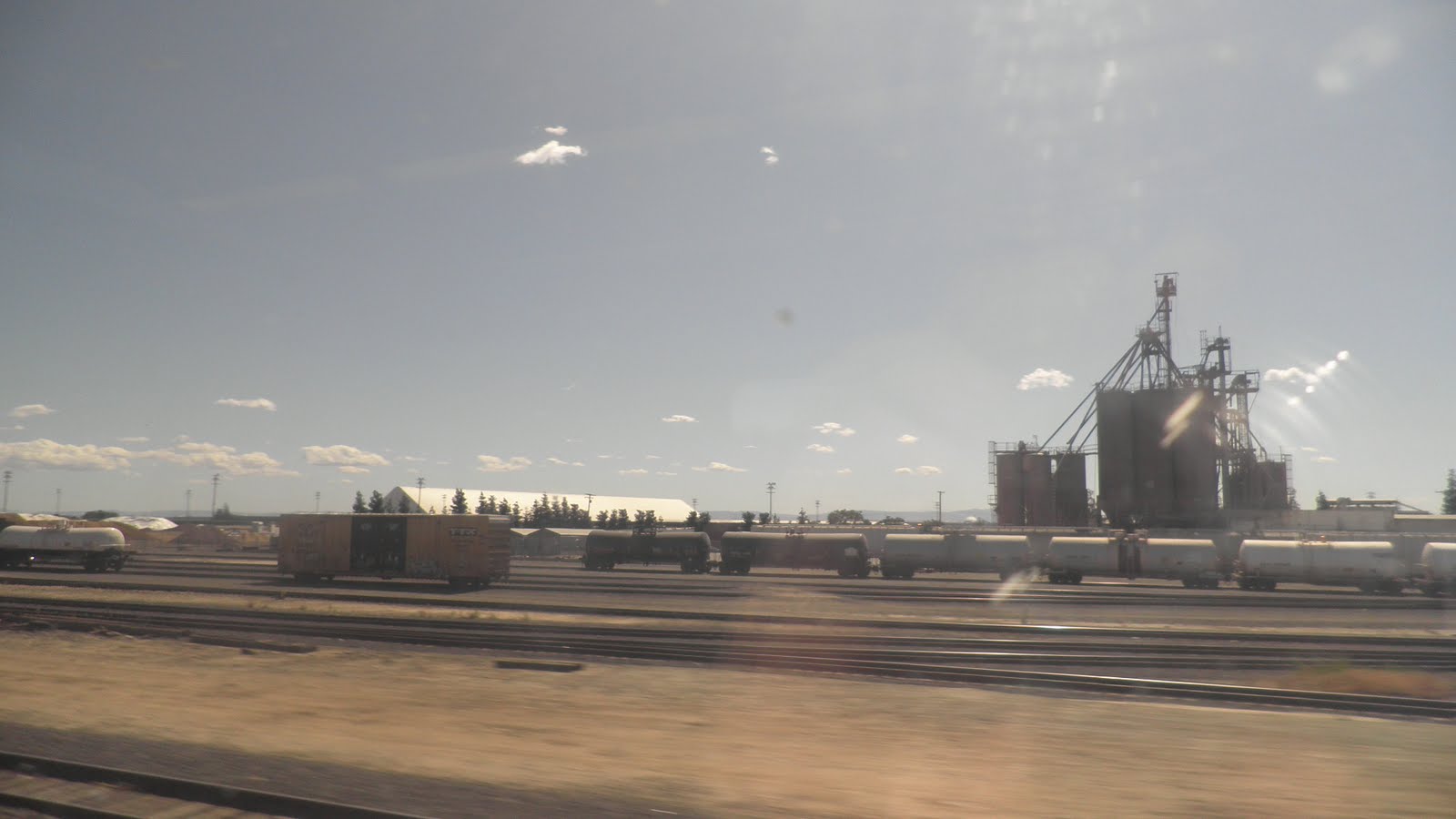
Fresno is not a city easily reachable by public transport. It still benefit from six trains per day thanks to the San Joaquin Line of the AMTRAK. A bus line manned by Greyhound is also available. An airport is present in the city but I have not really checked for that opportunity.. I took the train and was a bit surprised by how slow it was going. Nevertheless, it was comfortable and I had a lot of space for my legs. It also gave me the opportunity to enjoy the rural landscape of California and to learn more about it. The countryside seems to be a really nice place often sunny, as it was this day, but I did not expect to see so many decrepit factories along the way. They reminded me of the 50’s-70’s. As expected, I saw a lot of orange trees field, vineyards and some beehives. Nevertheless, there is a difference between a city like San Francisco and this countryside which seems to be stuck some decades behind as the towns that the train serves have a kind of miserable feel about them that does not lent toward dynamism. Interestingly it reminds me that in America, cheap can sit with no shame next to poshness. In addition of being the country of opportunity, the USA are perhaps also a country of great contrasts whether they be geographical or social. Overall, the car remains the best way to reach it and enjoy the city.

Indeed, the city’s structure reminded me a lot of Johannesburg in South Africa. Down-Town is kind of deserted and riddled by crime, as I was told. It was a sad thing for me to see as I hate a city with no real centre. Some buildings deserve more attention and the central streets could use more high-profile trade and shops rather than some cheap Hispanic shops. As a matter of fact, most of the big name will be found in malls scattered all over the city. And as the commuting is pretty much inexistent and that the city has expanded a lot, walking is not an effective way to reach a point, even for me! So the car remains the best way to travel around. It is obviously a vicious circle as nothing seems to be done to make people walk more. I am curious to know if the situation of Fresno, fifth biggest city in California with more than half a million inhabitants, is unique in America or if second rate cities across the country share the same flaw. Looking at the demographic statistics reveals that the city population boomed in the 90’s and that it probably suffered from a bad city development and now it would take a lot of effort to restrain the expansion of the city as no buildings exist in order to stall it. So the more the city grows, the more it expands and the more things get scattered.


The proximity of a lot of natural parks should make of Fresno an ideal hub but it seems to be left unexploited and I am pretty sure that the fact that it is hard to be reach for tourists and backpackers does not help at all. In addition, the city is barely known abroad. I have a feeling that a lot of things could be done in this city but that people do not know how to deal with it because most of the competent persons leave the city and only the less motivated stay. Indeed, in the current state; why would they stay when they could go to bigger and more exciting cities? Interestingly, one of its sister’s cities is Verona in Italy: a city cradled in culture and history; it should be for Fresno a great way to improve its own status. Indeed, if the USA is not reputed for its fine culture and its long history, they are on the other hand a major actor on the outdoor’s activities scenes and Fresno happens to be close to a lot of them while being not so far from seaside and mountain activities. If the city is broke, why could not they use their potential outlaws, since crime is rife there, to help them develop the city instead of parking them into some overcrowded prisons? What’s going on there?
-C
Friday, May 28, 2010
Washington D.C.: the sanctuary of a culture

I will start my observation with the travel system. If the commuting system at the Logan airport of Boston is quite clearly indicated, it is not what I thought about Dulles airport in Washington DC. Tickets in the metro are not valid for 24h as in New York and Boston but just for a day. Like at Dulles, the indications are not crystal clear as to where one is going. On the other hand, it is clean, spacious and allows going across the city quickly.
The city shelters a lot of free museums, most are located around the National Mall, which have been made possible thanks to the donation of British scientist Mr James Smithson , whose testament helped to create the Smithsonian Institute: “an establishment for the increase and diffusion of knowledge among men.” Interestingly Smithson never set foot in America.
The first one of them that I visited was the Museum of Air and Space. It reminded me of the museum of Le Bourget near Paris. I guess that every museum about air and space are similar, nevertheless it is a very interesting place explain the history of the planes and what challenges are faced nowadays in space notably. It showcases a lot of planes and for the majority experimental vessels which are sometimes unique. However, it sounds to me as if the USA invented the plane; the USA obviously carried out the bulk of the aeronautical innovations after WWII but before it was not the case and this, to me, not clearly pointed.

The National Museum of the American Indians, recently opened, seemed to be part of the political correctness tendency of the USA to please its minorities. It is not that it should not be done, but the reason makes it sound less genuine that it could be. As a result it is suppose to justify the existence of the native communities across the country. Their main message is to tell people about what is it about being a Native American and that their culture is trying to survive. “It is in my blood so i am a Native American and as a result I cannot ignore it” or “Fishing has been the main activity of my ancestor so I am myself a fisherman...” are the kind of testimony that the visitor can read. The bottom line seems to be pretty much naive as all cultures and peoples fight for “survivance” and succeed in different ways; political correctness is what saved the Native American. It shows that these communities do not adapt and choose to continue their ancestral activities in the face of evolution. Not to say that it is stupid and sound too harsh but as we say in France “c’est la vie!”; adapt or die is what life is probably all about as history teach us. The museum boasts a large collection of presentation of different Indian people but it makes it hard to distinguish all of them.
The Smithsonian Institute Building is a red brick neo gothic castle built in 1847 and is the hub of all the Smithsonian museums. It displays an eclectic collection of objects drawn from various eras which is probably supposed to give an outlook of what the museum of the Smithsonian Institute can offer.

On the next day I went to the National American History museum. There were exhibitions about the dresses of the first ladies, about the American flag in Baltimore during the war of 1812, Americans at war and other patriotic subjects such as anti-slavery. It is an interesting museum to get a first glimpse of American History; however the later is much more complex and less heroic and glamorous than told, as it is with any history.
The nearby National Portrait Gallery, did not raise a lot of enthusiasm in me I was not very interested in viewing all the portraits of various political figures of different political eras of the US history exhibited in most of the museum’s rooms. Neither did I particularly appreciate the exhibition on “American” arts.

I finished with visiting the Georgetown area and its campus, like Harvard it looks like a British campus only with grey brick instead of the traditional red ones. Not much to say about it except that the area of Georgetown is much more friendly and lively than the centre of the city.

The number of memorials of “recent” nature, as opposed in European countries tends to prove this justification. But every country, notably my own, has a city dedicated to that kind of historical justification and mythology, so how could I blame them for that? As it happened in Europe, will this trend ends and see a change and maybe an end in the militaristic culture of the USA? Does a historical circle exist? I, for one, believe that it might be possible, however I will be long dead when it happens, as I believe it will take a few generations to happen, if I observe how it happened in Europe.
-C
Monday, May 17, 2010
Boston

On my first day there, I did not have the time to visit anything as I arrived in the middle of the afternoon. It remained that as the weather was sunny, it was a good occasion to visit the city and scout for my next day. Even though my hostel was in an industrial suburb, called Everett, (or what seemed to be so) of Boston and far from down town, it only took me half an hour to reach any important point of the city. In addition I found that the indications in the metro and bus were quite clear, things that puzzled me in New York from time to time. Moreover, the city was really really clean especially compared to New York and much greener somehow although I did not seem to see more trees in Boston, probably the fact that Boston down town count less skyscrapers. As a result of all this free time to roam around and walking along the harbor of Boston proved to be a good opportunity to be liberal with my camera. Unfortunately my battery died at the critical moment: sunset; gutted, I swore to not let pass this occasion the next day. And I thus went back home with my tail in between my legs, although this walk proved to me that Boston was a pretty city taking full advantage of the sea unlike New York.
On my second day, I raced to the Museum of Fines Arts and stayed in for 3 hours, almost as much as in the Metropolitan. I enjoyed an exhibition of Durer and went through the whole museum. What I found odd is that there were not that many people in the museum, it felt a bit empty even on a Sunday afternoon. The cards giving indications on each works sounded a bit stupid sometimes, giving sometimes useless details like " this works shows someone falling like a paratrooper, a type of soldier introduced during WWII". It just sounded a bit odd sometimes. There was also an exhibition on the excavation of an Egyptian tomb. Here again, a lot of superlatives were used in the various description as if it was a world first. I took the opportunity to have a lunch in their garden which proved something wise as the sunshine was warm, fact that surprised me being in Boston. Overall I liked the possibility to see different art from everywhere but I also felt that sometimes there was a lack of coherence between the works exhibited or that the collections shown were too little. Something was definitely missing. Besides, I noticed in Boston that every wing, escalator, wharf or bench were dedicated to someone that died, as if people in America were afraid to die without leaving their names written somewhere. I noticed this tradition in England, only on benches though, but not to that extent. Why would someone have an escalator named after him/her when dead? It might seems nice and respectful but I just could not bring myself to fully find it this way, I found it a tad superficial or probably the fact that it was done on every possible object.

I then decided to go to Harvard. Going there, I discovered that what I thought was downtown was not and I thus understood I had more walking to do. Before going to Harvard, I went to the MIT campus first and then on the banks of the river Charles. The sight of the river filled with white sails, with the financial center in the background was quite breathtaking and I must say that it really made my day. I knew that it would be the spot where I would the sunset. So I set to reach Harvard campus located in a part of Boston ironically called Cambridge although, the campus reminded me more of Oxford...Nothing special to declare about the campus as it looks like as I said earlier like Oxford. Old red brick houses with lots of trees around: a nice place to study and idle when you find yourself with too much time on your hand. As the afternoon was closing to the evening, I decided to ambush the sunset and after monopolizing a bench (un dedicated this time but I spotted a dedicated pedestrian bridge!) for two hours and after much experimentation with my camera and its settings, I could at last take some nice pictures involving boats, a river, a sunset in an urban environment. It proved at least to me rewarding and I thus went home again in the lovely Everett to spend my last night, I planned the next day to go to the Institute of Contemporary Art but it was unsurprisingly closed on Monday.
Granted that I did not go to the Tea Party Museum, the Institute of Contemporary Art , the Harvard Art Museum, the Aquarium nor did I went on a boat trip checking the islands around. Would it have changed my overall perception of the city? I don't think so. I enormously enjoyed the city but I felt it was to tiny compared to what I am used to lived there in a pleasant manner, even though if I was offered a good job there I would not decline it either. Maybe it is the provincial side of the "Athens of America" that turned me off, probably a reflex from people coming from "big cities". Something is simply missing, maybe the buzz of something more speedy? I would not consider myself as a hardcore Parisian but on my first impression of Boston, I found this buzz missing a lot and now slightly frustrating.
-C
Friday, May 14, 2010
New York, part II
My stay in New York is reaching its end and out of these three weeks that I spent there, here are my thoughts.
As for Manhattan itself, I found it quite windy and that there was a smell of food everywhere thanks to the little stands present in the street selling hotdogs and Co. The weather is really fluctuant and reminds of England. Indeed, it could be very hot and then very cold on the next day. The Tube stations are not always very well designed (i.e. 86st street/Lexington station) because one must go outside in the street in order to reach the other platform, something I did not find very intuitive. In contrast, the possibility to take either an express metro or a metro going to more local stations is a smart idea. I enjoyed a lot walking in Manhattan and all sort of sculptures present in the city. It also boasts some nice places to take a drink sometimes and other mini gardens are present which makes it easier to eat a sandwich in the shade. The geometrical disposition of the town makes it easy to navigate in unlike the European cities but on the other hand, it makes it less charming as a result in my opinion. I went to the top of the Rockefeller Centre at night time; the vista on the 60th+ level on NY is enchanting.
Having lived in Harlem for most of my stay, I had some apprehension with violence and security but finally, I never had to deal with any of these troubles; that said, I do not think that I would live there eternally and I felt a bit out of place as being one of the few white person in suit walking around these streets. Being an area populated mostly by the black community, most of the streets and avenue are renamed with a famous black person; as an example, I was living close to Martin Luther King Jr. Blvd and Malcolm X Avenue. For some reasons, a lot of churches are present. They are not always in a proper church building and can be found in classic buildings. I guess that faith is an important part of the culture of the people residing there. I heard of some masses being packed and that booking was necessary in order to join. Nevertheless, I did not have enough time on my hands to assist to some Gospel choirs. I have also noticed that a lot of crippled people wander in the area either with a single crutch or in a wheelchair. I have absolutely no idea why it is like there and not in the other part of the city I have been in. Apart from the campus of Columbia University which is nearby and the Morningside Park that offers a view toward Central Park, I do not think that there is a lot to see there.
 On Sunday, I went to Battery Park again: the heart of Manhattan and its historical area. With its narrow streets and its tall skyscraper, lower Manhattan gives the feeling of being overwhelmed; in addition, as it is the oldest part of NY, the streets do not all benefit from the grid system. These narrow and curvy streets add to this feeling. It also proposes some nice photo opportunities thanks to the perspectives offered by the buildings. The famous Wall Street is also around as is the bronze Merrill Lynch’s bull [ERRATA: the bull symbolize the rising trend of the stock auction as opposed to the bear which symbolize the fading trend, Wall Street traders are strong believers in the bull] ; interestingly enough the parts that have been the more touched are golden and are its head and genitals...classy...From there it is possible to look at Brooklyn and the Queens and their bridges on the East River.

I then proceeded to go to Staten Island from the Lower Manhattan ferry station. The urban architecture doesn’t look like Manhattan or any big city. Actually, it looks like something miles away from the very urban downtown but it makes a good change from time to time to switch to a more suburban environment. However, it looks as if it was stuck in the eighties and I found it a slightly depressing side as not much seemed to happen there. South beach provides a good walk thanks to the wooden boardwalk. It felt a bit surreal to walk there as I was less than an hour away from downtown. To access it, a ferry at Battery Park is available and it is free, it also allows having a stunning view on the statue of the Liberty, Ellis Island and the skyline of Manhattan. My trip was very very windy but it was an excellent opportunity to take pictures. The metro card works also on the island and let people take advantage of the bus network.
The Upper East Side is a posh area of New York, with all the hype and prestigious shops notably on Madison Avenue and close to the museum mile (including notably the Metropolitan Museum, the Guggenheim, the Frick Collection and the Whitney museum of American Art). It remains a nice area where to wander although the nearby Central Park is a much better option. I went to the Whitney Museum which the museum for the American Art. It hosted its biennal and a tons of different artists on 5 levels. What marked me the most was this series of picture by Nina Berman about this horribly mutilated 24 years old Marine going back from Iraq and getting married. His would-be wife on the pictures did not seem that joyful which is understandable. It concluded that in the USA the military culture and its consequences were seen as acceptable. The rest of the works exhibited was not really worth it as there was not anything that holding some esthetical value to my eyes.

I also went to the famed MOMA, museum of contemporary art of New York, which current exhibition was on the South African artist William Kentridge, depicting pieces of art denouncing the Apartheid and the cruelty of mankind; it was obviously rather depressing and dark. The MOMA boasts a nice collection of contemporary classic including some Warhol, Lichtenstein, Klein and other figures of the post-war and contemporary period. A gallery dedicated to the history of mundane items design is there and it is interesting to observe that some form of art can be found in these objects. A garden allows people to chill out in the shades of the skyscrapers and offer another example of the NY urban feeling.
Walking toward Central Park can be found the Frick Collection. This impressive collection of paintings and works from European old masters and renaissance era are nestled in an equally impressive building. Constituted at by Henry Clay Frick , an industrial tycoon from Pittsburgh, who desired to turn his New York residence into a museum after his death. The house was conceived from the start to host art works as the windowed ceiling in the main gallery can show. In addition, the house which is built according to the standard of the nineteenth century possesses an internal garden with a fountain that was added after the death of the magnate, it is however covered up by a windowed ceiling. It is relatively small compared to the other museums around but its collection does not have to blush of its size. It is perhaps why the Frick is one of my favourite museum in New York.

On the other side of the 5th Avenue lies Central Park. It is a little paradise for the joggers and they literally proliferate on the week end. It is also one of the few big green spaces available in New York, let alone Manhattan. It offers some magnificent view on the skyline of New York from the northern side of the city. It features some big water plan like the Jackie Onassis Reservoir, which could be a potential place to sail, and the Harlem See where people can fish. The Conservatory Garden let people relax amongst its plants and hedges. It is possible to play different sports in different parts of the park and to bike/skate on its road during the week end as the later are closed to the cars. I believe that it is an excellent place to relax on a Saturday afternoon, on the other hand, it will not be a very quiet place given the amount of people going there.
With the end of my article is also the end of my stay in the Big Apple and I wish I could stayed longer to explore more of it and its nightlife. I find it very different from the other cities I have been to, notably the European cities and even if less charming, more urban than its older sisters, New York remains a fantastic city to go and live in for anyone enjoying the buzz of a major city. Overall, what ticked me the most was that posh places could be found next to some miserable ones downtown and the state of the streets which could use some renovations.I will be then off soon to Boston and Washington DC..
-C
As for Manhattan itself, I found it quite windy and that there was a smell of food everywhere thanks to the little stands present in the street selling hotdogs and Co. The weather is really fluctuant and reminds of England. Indeed, it could be very hot and then very cold on the next day. The Tube stations are not always very well designed (i.e. 86st street/Lexington station) because one must go outside in the street in order to reach the other platform, something I did not find very intuitive. In contrast, the possibility to take either an express metro or a metro going to more local stations is a smart idea. I enjoyed a lot walking in Manhattan and all sort of sculptures present in the city. It also boasts some nice places to take a drink sometimes and other mini gardens are present which makes it easier to eat a sandwich in the shade. The geometrical disposition of the town makes it easy to navigate in unlike the European cities but on the other hand, it makes it less charming as a result in my opinion. I went to the top of the Rockefeller Centre at night time; the vista on the 60th+ level on NY is enchanting.
Having lived in Harlem for most of my stay, I had some apprehension with violence and security but finally, I never had to deal with any of these troubles; that said, I do not think that I would live there eternally and I felt a bit out of place as being one of the few white person in suit walking around these streets. Being an area populated mostly by the black community, most of the streets and avenue are renamed with a famous black person; as an example, I was living close to Martin Luther King Jr. Blvd and Malcolm X Avenue. For some reasons, a lot of churches are present. They are not always in a proper church building and can be found in classic buildings. I guess that faith is an important part of the culture of the people residing there. I heard of some masses being packed and that booking was necessary in order to join. Nevertheless, I did not have enough time on my hands to assist to some Gospel choirs. I have also noticed that a lot of crippled people wander in the area either with a single crutch or in a wheelchair. I have absolutely no idea why it is like there and not in the other part of the city I have been in. Apart from the campus of Columbia University which is nearby and the Morningside Park that offers a view toward Central Park, I do not think that there is a lot to see there.


I then proceeded to go to Staten Island from the Lower Manhattan ferry station. The urban architecture doesn’t look like Manhattan or any big city. Actually, it looks like something miles away from the very urban downtown but it makes a good change from time to time to switch to a more suburban environment. However, it looks as if it was stuck in the eighties and I found it a slightly depressing side as not much seemed to happen there. South beach provides a good walk thanks to the wooden boardwalk. It felt a bit surreal to walk there as I was less than an hour away from downtown. To access it, a ferry at Battery Park is available and it is free, it also allows having a stunning view on the statue of the Liberty, Ellis Island and the skyline of Manhattan. My trip was very very windy but it was an excellent opportunity to take pictures. The metro card works also on the island and let people take advantage of the bus network.
The Upper East Side is a posh area of New York, with all the hype and prestigious shops notably on Madison Avenue and close to the museum mile (including notably the Metropolitan Museum, the Guggenheim, the Frick Collection and the Whitney museum of American Art). It remains a nice area where to wander although the nearby Central Park is a much better option. I went to the Whitney Museum which the museum for the American Art. It hosted its biennal and a tons of different artists on 5 levels. What marked me the most was this series of picture by Nina Berman about this horribly mutilated 24 years old Marine going back from Iraq and getting married. His would-be wife on the pictures did not seem that joyful which is understandable. It concluded that in the USA the military culture and its consequences were seen as acceptable. The rest of the works exhibited was not really worth it as there was not anything that holding some esthetical value to my eyes.

I also went to the famed MOMA, museum of contemporary art of New York, which current exhibition was on the South African artist William Kentridge, depicting pieces of art denouncing the Apartheid and the cruelty of mankind; it was obviously rather depressing and dark. The MOMA boasts a nice collection of contemporary classic including some Warhol, Lichtenstein, Klein and other figures of the post-war and contemporary period. A gallery dedicated to the history of mundane items design is there and it is interesting to observe that some form of art can be found in these objects. A garden allows people to chill out in the shades of the skyscrapers and offer another example of the NY urban feeling.
Walking toward Central Park can be found the Frick Collection. This impressive collection of paintings and works from European old masters and renaissance era are nestled in an equally impressive building. Constituted at by Henry Clay Frick , an industrial tycoon from Pittsburgh, who desired to turn his New York residence into a museum after his death. The house was conceived from the start to host art works as the windowed ceiling in the main gallery can show. In addition, the house which is built according to the standard of the nineteenth century possesses an internal garden with a fountain that was added after the death of the magnate, it is however covered up by a windowed ceiling. It is relatively small compared to the other museums around but its collection does not have to blush of its size. It is perhaps why the Frick is one of my favourite museum in New York.

On the other side of the 5th Avenue lies Central Park. It is a little paradise for the joggers and they literally proliferate on the week end. It is also one of the few big green spaces available in New York, let alone Manhattan. It offers some magnificent view on the skyline of New York from the northern side of the city. It features some big water plan like the Jackie Onassis Reservoir, which could be a potential place to sail, and the Harlem See where people can fish. The Conservatory Garden let people relax amongst its plants and hedges. It is possible to play different sports in different parts of the park and to bike/skate on its road during the week end as the later are closed to the cars. I believe that it is an excellent place to relax on a Saturday afternoon, on the other hand, it will not be a very quiet place given the amount of people going there.
With the end of my article is also the end of my stay in the Big Apple and I wish I could stayed longer to explore more of it and its nightlife. I find it very different from the other cities I have been to, notably the European cities and even if less charming, more urban than its older sisters, New York remains a fantastic city to go and live in for anyone enjoying the buzz of a major city. Overall, what ticked me the most was that posh places could be found next to some miserable ones downtown and the state of the streets which could use some renovations.I will be then off soon to Boston and Washington DC..
-C
Saturday, April 24, 2010
New York


The Guggenheim Museum was my first stop in the city and it harboured the Haunted exhibition. It represented a series of pictures representing the past and symbolising melancholy and a haunting feeling due to the past. According to the website, the explanation is that “much of contemporary photography and video seems haunted by the past, by ghostly apparitions that are reanimated in reproductive media, as well as in live performance and the virtual world. By using dated, passé, or quasi-extinct stylistic devices, subject matter, and technologies, this art embodies a melancholic longing for an otherwise irrecuperable past.” This painting somehow touched me more than then rest, probably because it represent a mysterious landscape and that I also like the way the colours are applied. Several exhibitions were present along this one but only the Thannhauser Collection retained my attention. It gathers a collection of classic modern painters including most of the Impressionists yet remains brief, a feat appreciated by your servitor.
I then turned my look on the nearby Metropolitan museum of Arts: a comprehensive museum, rather a supermuseum, which regroups a vast array of artefacts from different civilisations in its permanent exhibitions. Someone could say that it is a clone of the Louvres, however its location and different collection makes it unique and nearly on par with the biggest museum in the world (it felt good to write that!) but makes it probably second to none bar this exception. It possesses galleries about various prime civilisations such as the Oceanic people with a nice collection of mask and the classic antique Greek, Roman and Egyptian galleries which boasts the impressive temple of Dendur from 15 B.C. in one of its room which also offer a view on Central Park. Its collection of classical paintings is also remarkable thanks to the actions of generous donators. It includes most of the Impressionists painters, the Flemish Masters such as Vermeer, the Spanish with Goya, a few English painting of notably Turner and Constable and of course the Italian painters from the Renaissance to later.

On a sidenote, I was happily enthusiast with Arkhip Kuindzhi's Red Sunset on the Dnieper which featured a vivid view over the taiga. Obviously it is only a part of the collections presented by the museum and it is to note that some reconstitution of parlour of various period and style are also present notably in the American Wing. Some American painters, notably Frederick Church through his Heart of the Andes, were talented landscapists.
As for the temporary exhibitions, I decided to avoid the Picasso exhibition because there are simply too many of them around the world and they get boring and mainly because his various styles do not inspire me. Instead, I went to see the art of illumination, which is under represented. It was about the Belles Heures of Jean de France, duc de Berry; not to be confused with the later work and masterpiece Très Riches Heures du duc de Berry. These illuminations represented “a book of hours—a prayer book made for private use in the intimate devotion to the Virgin Mary that grew popular toward the end of the Middle Ages. In addition, it also includes seven “picture book” cycles that tell stories through a succession of full-page illuminations, with text limited to a few lines in alternating red and blue ink. These sections, which were added by the Limbourg brothers in the later stages of the manuscript’s production, show the artists’ increasingly developed power. The brief texts included on the pages are not devotional, like the texts in a typical book of hours, but rather relate stories from the lives of the saints.” Magnifying glasses were available in order to admire these rare objects and the presentation was quite good; in addition the exhibition was not too long which is always a plus in my book.
After being in museums for so many hours, I decided to walk and ventured quickly through Grand Central Terminal and its vast hall with an astronomical painting on its ceiling. I opted to walk toward Battery Park at the bottom of Manhattan and went to see the site of the 9/11 attacks and the remains of the World Trade Centre filled with cranes and other construction and public works installations, Ground Zero, bound to be replaced by a tower recalling the event, the Statue of the Liberty and Castle Clinton and went back via Broadway.


I continued my journey in Manhattan and came across the Flatiron building and last but not least: the famed Time Square which was awfully overcrowded and reminded me of the busy sidewalk of the boulevard Haussman near the Printemps and Galleries Lafayette and Oxford Circus in London, some places that are best to avoid, as a result I quickly looked at the giant boards.
Overall, I walked for around 25km and feel humbled by the sheer size of the Big Apple. At first, I thought that Paris was bigger but then I remembered that it was only Manhattan and not the whole city. On the other hand, I wonder if the other parts of New York are that interesting but I would feel too disappointed as there are always some parts of a city which are less appealing.
-C
Tuesday, April 13, 2010
Tea Party

On Saturday, my hometown and current residence had a ‘Tea Party’. This new form of political activism that is argued to be rightist and fanatical and ignorant was not as the media has presented it. The rally was quite tame with vendors and information booths. People seemed friendly and open to promoting positive change not destruction. However, it appeared just like any political activism, politics. They are just as much a group trying to gain money and power, like any other. Republican candidates for example had tables to talk to prospective voters and appeal for their bid. One form just replaced another. The masks on the political machine are changing but the ‘tea party’ was begging for money just as any other party or candidate would. However, their message is clear that they are not a political party. Then why do they need money? They are peaceful protestors who sell t-shirts and take donations. I guess this money will be distributed to the homeless or the US Treasury or lobbyists asking for reduced government or someone’s pocket?
The event had booths around the periphery and the center had the rally with speakers and the audience which let out periodic cheers with the wave of an American flag. The core values (as printed in the event’s program) are fiscal responsibility, limited government, and free markets. These are not radical in my opinion or out of line with a more conservative view of American government. So where does the opinion come from that these are radical conservatives?
The program also included the top ten disasters of Obamacare. I will outline them from the event program to provide a better glimpse into these disgruntled citizens’ distress with the new health care plans.
1. New spending grows the federal deficit
2. Bending the cost curve in the wrong direction (meaning increasing health care spending overall not decreasing it)
3. New taxes and mandates hinder economic growth
4. Regulations grow government control over health care
5. Expanding broken entitlement programs
6. Burdening state budgets (because it requires expansion of state run health programs)
7. Neglecting Medicare (the current health care safety net)
8. Creates discrimination against low income workers (incentive to avoid hiring workers from low income families)
9. Exchange eligibility creates inequality (unequal subsidies towards health care purchases)
10. Questions of constitutionality (requires all Americans to purchase health care, which extends congressional power)
From these I think there are some more significant points than others. Numbers 1, 4, and 10 are the most concerning to me. I feel that government regulation is necessary in certain cases and health care is one such thing (to an extent). Increasing power beyond constitutional restraint to control a market is against our principles on both economic and political levels.
~PB
Wednesday, April 7, 2010
Is the sun setting on California?

I can see the point of why it would be easier to save and gain money. I am also aware that the judiciary system in California is tough and thus it is one of the main causes in the overpopulation of its penitentiary facilities. 150,000 inmates are at the moment in the prisons and the bill aims to reduce this number by 55,000 over 3 years by shortening sentences, releasing people inculpated for minor sanctions and other mechanics. Prisons are often reaching the double of their designed capacities making the living conditions in them hard to manage; classrooms and gymnasiums had to be converted so that they could allow prisoners to sleep in. This reform would save from $803M to $906M per year and is endorsed by Governor Schwarzenegger. However, this problem does not only concern the state of California but the whole country, and as a matter of fact a lot of nations suffer from this problem. In 1972, there were 172,000 prisoners in the USA while now this number has skyrocketed to 1,403,091 people.
The bill on the legalisation of the marijuana would make of California the first state to legalize its use in the USA. A poll in April 2009 revealed that 56% of the Californians were favourable to it while in October 44% of the Americans would not mind this step. Proponents argue that it would diminish crime linked to the traffic as the ban has bolstered an aggressive underground economy while opponents argue that it would increase the problems linked to social behaviour notably on the road.
This bill, if passed, in conjunction with the prison bill would allow California to significantly reduce its prisons population and increase its finances thanks to a tax on the commercialisation of marijuana.

I am a bit dubitative at this double decision as I do not really know what would be the impact of such measure on the society. Does this mean that the cartels controlling drug traffic are going to be out of business without trying anything and thus crime will fall? Does this mean that people susceptible of a federal offense will take more liberties confident in the fact that minor crimes will be less punished? Will there be more troubles linked to the consumption of marijuana? Or are these more laxist measures supposed to perpetuate the ideal of happiness in the country blessed by God?
These events combined with the failure of the education in California do not announce a bright future to me. I do not really see how it would be beneficial for the society to profit from these bills. Is it a sign of the degeneration of the American society or of an evolution?
-C
Monday, March 22, 2010
USSA
I take this line from a friend of mine who is liberal and has no trouble comparing the USA to the USSR. I find this somewhat frightening. He did so somewhat with amusement thinking this progress is good. By progress I mean, the passage of the health care bill in the US Congress. Health care reform is not all bad and actually a necessity in the contemporary climate but I have my reservations about its passage which I am sure sparks grumblings in my European friends.
I will not summarize the contents of the bill partly because I don't know much truth about it, which brings me to my first concern...
1) Why is the bill not viewable by the public? We are the government we should have access to such legislation especially when the President promised it to us. I cannot trust the media or the politicians to tell me what is in the bill.
2) Costs I believe are underestimated. Cost will go up with the government regulation (control) over supply.
3) Regulation can be a good thing but controlling the market diminishes incentive and limits the abilities of capitalism to work. I understand market failures and the need for government but whether or not this is the appropriate method is debatable for me.
4) The government will require every person to buy health insurance. This makes people pay the government just to live. It is human right to live not a privilege. We are granted life, liberty, and the pursuit of happiness but I have to write a check to the government to live? The government now grants my life--controls it?
5) Taxes will be collected for four years prior to the payout of benefits. I understand the need to maintain a budget but this isn't about paying for the program later, it is about collecting more money now for excessive spending.
6) Legislators would not listen to the concerns of the people. Our representatives were granted powers as delegates, not trustees, and if people are concerned why not take time to educate them on why this is important and show them the benefits of the bill as opposed to saying that the American people will like it later. Hmmm. Don't put words in my mouth.
7)This last point leads to my next one. If government doesn't listen or respect its people and there concerns then I am concerned about more than the bill. I have enjoyed the benefits of socialized medicine in the UK and I will admit that there are advantages so education and analyzing appropriate methods would have been the best direction. People should understand the benefits of social welfare systems but they also need to realize that they have a price. Americans don't tend to understand this nor what 'socialism' is.
I opinion is that this was poorly organized and damages the image of American government. However, President Obama and his agenda were what won the election so this is the result. Have the people spoken?
I will not summarize the contents of the bill partly because I don't know much truth about it, which brings me to my first concern...
1) Why is the bill not viewable by the public? We are the government we should have access to such legislation especially when the President promised it to us. I cannot trust the media or the politicians to tell me what is in the bill.
2) Costs I believe are underestimated. Cost will go up with the government regulation (control) over supply.
3) Regulation can be a good thing but controlling the market diminishes incentive and limits the abilities of capitalism to work. I understand market failures and the need for government but whether or not this is the appropriate method is debatable for me.
4) The government will require every person to buy health insurance. This makes people pay the government just to live. It is human right to live not a privilege. We are granted life, liberty, and the pursuit of happiness but I have to write a check to the government to live? The government now grants my life--controls it?
5) Taxes will be collected for four years prior to the payout of benefits. I understand the need to maintain a budget but this isn't about paying for the program later, it is about collecting more money now for excessive spending.
6) Legislators would not listen to the concerns of the people. Our representatives were granted powers as delegates, not trustees, and if people are concerned why not take time to educate them on why this is important and show them the benefits of the bill as opposed to saying that the American people will like it later. Hmmm. Don't put words in my mouth.
7)This last point leads to my next one. If government doesn't listen or respect its people and there concerns then I am concerned about more than the bill. I have enjoyed the benefits of socialized medicine in the UK and I will admit that there are advantages so education and analyzing appropriate methods would have been the best direction. People should understand the benefits of social welfare systems but they also need to realize that they have a price. Americans don't tend to understand this nor what 'socialism' is.
I opinion is that this was poorly organized and damages the image of American government. However, President Obama and his agenda were what won the election so this is the result. Have the people spoken?
Thursday, March 18, 2010
To protect or not

If EADS is a European company, the incorporation of Northrop, a Californian defence firm, was supposed to help with this negative image and it also planned to build a factory in the USA to manufacture the tankers based on a version of the civilian A330. On the other hand, Boeing would build its tanker, based on the smaller 767, in USA too; however it is arguable that the Boeing tanker would have an all American plane as most of its components are outsourced abroad.
This end of the competition is mainly due as what is seen as some form of protectionism by the USA in favouring Boeing. Indeed the first leg, in February 2008, of the competition was won by EADS/Northrop but Boeing protested that the plane of its rival was not conform, even though it was deemed better, to the contract. As a result the offer was remade and this time Northrop felt it had to pull out. Its CEO observed that this contract clearly favoured Boeing.
The EU commission threatened to bring the whole case in front of the WTO and the leaders of France and the United Kingdom Mr Sarkozy and Mr Brown, amongst others, showed their disapproval of such a behaviour especially since protectionism is “a policy that the USA usually warns other countries against.”

However the facts remain that it is another feud between the EU and the USA in the trade sector. This contract might have an influence on how the F35 JSF will happen. Indeed, it is overdue and its price still rising. If the USA does not act smoothly with its European allies, why should they expect them to continue to act in a polite manner? Even the United Kingdom, the best ally of the USA, is unhappy. Competition is rising everywhere in the world; I would not advocate starting a mini trade war between strong allies.
-C
Sunday, February 21, 2010
partnership or rivalry?

These last weeks had shown that the relationship between the USA and China was not as close at it had seemed to be but rather maybe just a convenient fling. In fact, following the Google charade this past month, the refusal of China to revaluate its currency, the Yuan, despite cries from the West, and the sale of weapons from the USA to Taiwan (worth $6,5 Billion) Chinese relationships have turned cold. As a result, the Asian giant decided to cut short all its military relations with the largest military power in the world. In addition, President Obama’s decision to see the spiritual leader of Tibet, the Dalai Lama, provoked another row with the Chinese—they do look favourably on foreign governments supporting the Buddhist leader. The behaviour of the Chinese government during the Copenhagen summit was also exemplary for its casualness and a major cause for its failure.
More and more, China has been seen as reacting in a capricious way. The media has been justifying this reaction because of the weight of the Communist state in the world economy. The Chinese for example, had enough power to cancel a visit to Europe last year because Nicolas Sarkozy, possessing at the time the presidency of the EU, was scheduled to meet the Dalai Lama. They further have the power to intrude in African affairs. The Chinese are not anymore largely welcomed in Africa by the locals as they can arguably be charged with exploiting African natural resources. (Claims, however, none too different from those made towards Europeans in Africa or even Americans in the Middle East). This lead Jack Straw to compared their actions to neo-colonialism, comment that he had to apologize for, of course.
These events seem to show that China is willing to prove the world that it is a force to be reckoned with. That is a fair request, however, how long will they be provoking the other nations? Indeed, China might be powerful but it suffers many problems internally and is heavily dependent on its exports and rely on a undervalued currency. It would probably not be wise for them to continue this behaviour and whether they possess the first population in the world doesn’t make them able to behave like nouveaux riches.
-C
Friday, February 19, 2010
Jobs for All?
An $80 billion job bill vote has been postponed in the US Senate. This bill is aimed at job creation and will expand a highway trust fund, provide a tax credit for employers hiring new workers, and a tax break for small business owners.
This is all excellent news to the unemployed lady at this side of the monitor but how much will this bill really do or accomplish? The proposed sum is an exorbitant amount of money and what sorts of jobs will result. Will manufacturing increase? Will the US actually increase production of something? Or will this money just get funneled into providing services? Services are necessary for both the domestic and international economies but without improving and expanding American infrastructure, the US will indefinitely suffer and will have a struggling job market. I find this will be the case because without growth in productive industries many people will begin to be left out of the job market. The car industry is a good example. Michigan struggles with unemployment and there are not many other places these people can work. How can a job bill provide something for these workers?
I am a skeptic over government expenses and I hope that efforts to expand the job market are successful because they are necessary especially for younger workers; I just don’t believe that throwing money at the problem will solve it. I think the American economy needs to be adjusted and shift away from services and towards the promotion of renewable and cleaner energy and transportation. Why focus on these industries? They are areas where the nation can improve infrastructure and can contribute on the international market. There is high demand for energy and efficient transportation. Americans have long forgotten the power of trains and have lost an interest for energy with their fingers in the Middle East. I urge the Senate to consider more explicit uses for the funds and hope that they attempt to target job growth in areas that will actually help the jobless and provide for a more successful future.
~PB
This is all excellent news to the unemployed lady at this side of the monitor but how much will this bill really do or accomplish? The proposed sum is an exorbitant amount of money and what sorts of jobs will result. Will manufacturing increase? Will the US actually increase production of something? Or will this money just get funneled into providing services? Services are necessary for both the domestic and international economies but without improving and expanding American infrastructure, the US will indefinitely suffer and will have a struggling job market. I find this will be the case because without growth in productive industries many people will begin to be left out of the job market. The car industry is a good example. Michigan struggles with unemployment and there are not many other places these people can work. How can a job bill provide something for these workers?
I am a skeptic over government expenses and I hope that efforts to expand the job market are successful because they are necessary especially for younger workers; I just don’t believe that throwing money at the problem will solve it. I think the American economy needs to be adjusted and shift away from services and towards the promotion of renewable and cleaner energy and transportation. Why focus on these industries? They are areas where the nation can improve infrastructure and can contribute on the international market. There is high demand for energy and efficient transportation. Americans have long forgotten the power of trains and have lost an interest for energy with their fingers in the Middle East. I urge the Senate to consider more explicit uses for the funds and hope that they attempt to target job growth in areas that will actually help the jobless and provide for a more successful future.
~PB
Subscribe to:
Posts (Atom)